Insights from the Field

Practical wisdom from 35 years across oil platforms, clinical settings, and manufacturing floors. Real patterns, tested approaches, and lessons that textbooks miss.

All
Leadership Reflections
Industry Insights
From the Field
Core Insights
Master's Toolkit
From the Field
A quiet semiconductor test floor at night, one test handler open with a small brush beside the test socket, an impasto painting for a field story on finding recurring problems in control chart notes

Read the Notes, Not Only the Points

🕓  

9

  min read

A dirty contactor showed up in the notes twice, on different shifts. Here is how a test floor found the reason, and how to count the notes on your charts....

Master's Toolkit
A steel control panel with four round push buttons in a row under a lamp, an impasto painting for an article on what a reaction plan should say

When the Metric Moves

🕓  

11

  min read

When a metric goes outside its control limits, the person on shift should know what to do first. Here is what a reaction plan should say, with a template....

Master's Toolkit
A long strip of graph paper pinned along a plant corridor wall under a lamp, a line of dots between two red lines, an impasto painting for an article on how to read a control chart

Watch the Metric Over Time

🕓  

11

  min read

A metric reviewed once a month cannot show a slow change. Here is how to read a control chart, and the three signals that a process has changed....

Master's Toolkit
A single sheet of paper pinned to a cork board beside a packaging line, an impasto painting for an article on what a control plan is

Who Looks After It Now?

🕓  

10

  min read

When a project closes, who looks after the gain? A control plan answers that: one process owner, one page, and four plain lines....

Leadership Reflections
Three stone footbridges over a river at dusk with only the farthest one lit, an impasto painting for an article on the questions leaders should ask

What Else Did You Consider?

🕓  

10

  min read

Before you approve a fix, ask what else the team considered. Here is why the first idea usually wins, and how leaders can change that....

Master's Toolkit
A clear lit walkway across a dark factory floor, an impasto painting for an article on how to get people to follow a process

Make the Right Way the Easy Way

🕓  

12

  min read

People skip a step when it is harder than the shortcut. Reminders help for a week. Here is how to make the right way the easy way....

Master's Toolkit
A long row of dark workbenches with warm light on the nearest one, an impasto painting for an article on how to run a pilot

Try It Small First

🕓  

12

  min read

Most teams run a pilot to prove a fix works. A better goal is to find what breaks while the change is still small. Here is how....

Master's Toolkit
A row of hand tools on a workshop wall with the light on one small plain tool, an impasto painting for an article on the solution selection matrix

Don't Take the First Fix

🕓  

12

  min read

Once the cause is found, most teams take the first fix someone suggests. Here is how to list better options and choose between them....

From the Field
A lamp-lit workbench with one finished bracket beside a long dark aisle of tagged crates waiting to move, an impasto painting for a field story on how to reduce lead time

The People Were Fast

🕓  

11

  min read

Every department was fast, but changes still took three weeks. Here is where the time went, and the four changes that cut it by more than half....

Master's Toolkit
An open logbook lit on a workbench in a dark machine room, an impasto painting on FMEA and writing failures down in advance

Failure, Written Down in Advance

🕓  

10

  min read

Every crew can name its next failure. Almost none writes it down. What an FMEA is, how to fill in one row, and the rules that make the ranking honest....

Master's Toolkit
Two brass gauges rising together above one shared pipe, an impasto painting on correlation vs causation in operations

Moves Together Is Not Causes

🕓  

8

  min read

Two lines moved together for a year and everyone knew the story. Nobody tested it. The four explanations behind any correlation, and how to test one....

Master's Toolkit
A long empty bench in a dim corridor with one folder waiting under a single lamp, an impasto painting on the 8 wastes of Lean and waiting

The Waiting Is the Process

🕓  

11

  min read

Ask how long the work takes and you get minutes. Ask how long the customer waits and you get weeks. The 8 wastes of Lean, and why the biggest one has no owner....

Core Insights
The DMAIC phases as one arc: five stepping stones crossed one question at a time, Field Notes No.10 by Maria Milo

One Question at a Time: The Whole DMAIC Arc

🕓  

8

  min read

Every improvement project that finishes answers five questions, in order. The DMAIC arc in plain words, and why the order is the method....

Master's Toolkit
Two bowls of grain on a worn counter, one barely fuller, an impasto painting on hypothesis testing

Seen Is Not Proven

🕓  

9

  min read

A first good month is not an improvement. Hypothesis testing in plain words: how much does the process move on its own, and is this gap bigger than that?...

From the Field
The Week After the Training

The Week After the Training

🕓  

8

  min read

A trained team is not a capable one. The gap opens on the first Tuesday back at the desk, and it is closed by a person, not a course....

From the Field
Stakeholder analysis: four pairs of hands on a rope, one not pulling

Nobody Opposed It: What Stakeholder Analysis Actually Prevents

🕓  

10

  min read

Most improvement projects do not fail because somebody objects. They fail because the change lands on a team measured on something it makes worse. What a stakeholder analysis actually prevents, and the one question that...

Master's Toolkit
Prioritize improvement projects: impasto painting of a hand choosing three keys from a crowded iron ring, headline 'You can't fix everything.'

You Can't Fix Everything: How to Prioritize Improvement Projects

🕓  

11

  min read

Every improvement list I have seen is honest. Almost none of them are decisions. A field note on the difference between ranking your problems and actually choosing between them....

Master's Toolkit
Cause and effect analysis field note: impasto painting of a fishing net spread wide on a dock at dawn

Cast the Net Wide: Why the Cause You Miss Is the One You Never Listed

🕓  

8

  min read

Most cause analysis fails in the first ten minutes, when a plausible answer arrives early and the list of possible causes never gets made. A field note on casting the net wide before you narrow....

Master's Toolkit
Impasto painting of a hand pulling a weed with a long taproot from dark soil, headline 'Pull the whole root.'

Root Cause, Not Symptom: Why the Problem You Keep Solving Keeps Coming Back

🕓  

7

  min read

The problem you keep solving keeps coming back because you have been treating the symptom, not the cause. A field note on root cause analysis and the Five Whys....

Master's Toolkit
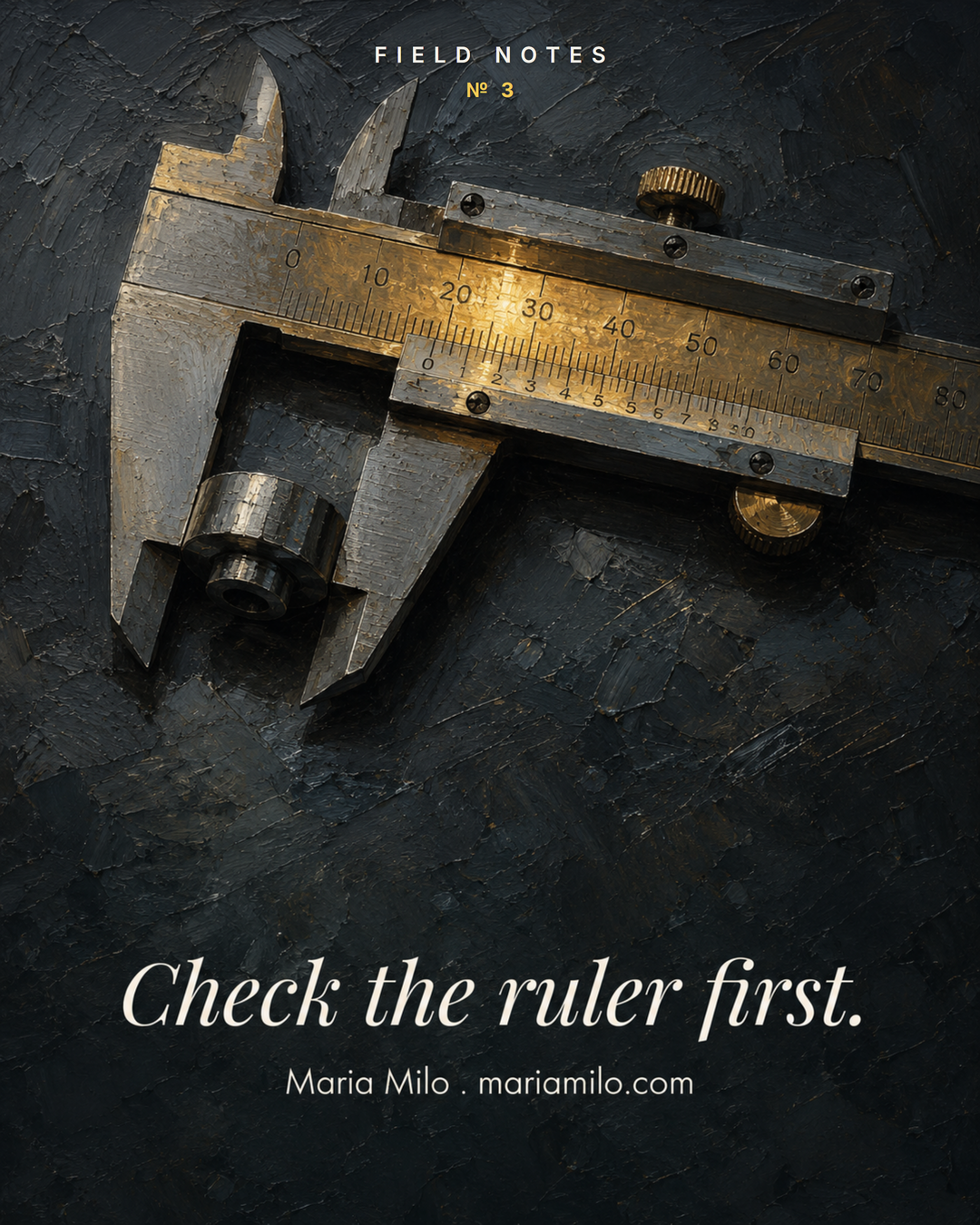
Impasto painting of a brass and steel vernier caliper on a workbench, headline 'Check the ruler first.'

Trust the Ruler: Why You Should Check the Measurement Before You Trust the Number

🕓  

6

  min read

Every measurement is the thing you want to see plus the error in how you saw it. A field note on trusting the ruler before you trust the number....

Get the FREE special report with the newsletter

The Dirty Dozen of Process Improvement

Resistance almost never looks like resistance. It looks like agreement in the room, followed by nothing happening. This 22-page report covers the twelve struggles that quietly end improvement work, the tell that gives each one away early, and one move to try on each. It arrives as soon as you subscribe.

By subscribing you are agreeing to receive Field Notes from me by email, roughly one short piece a week. The report comes first. Unsubscribe in one click, any time.

Form Submitted. Please check your email to confirm your sign-up. Thank you.

Oops! Some Error Occurred. Please try again.